
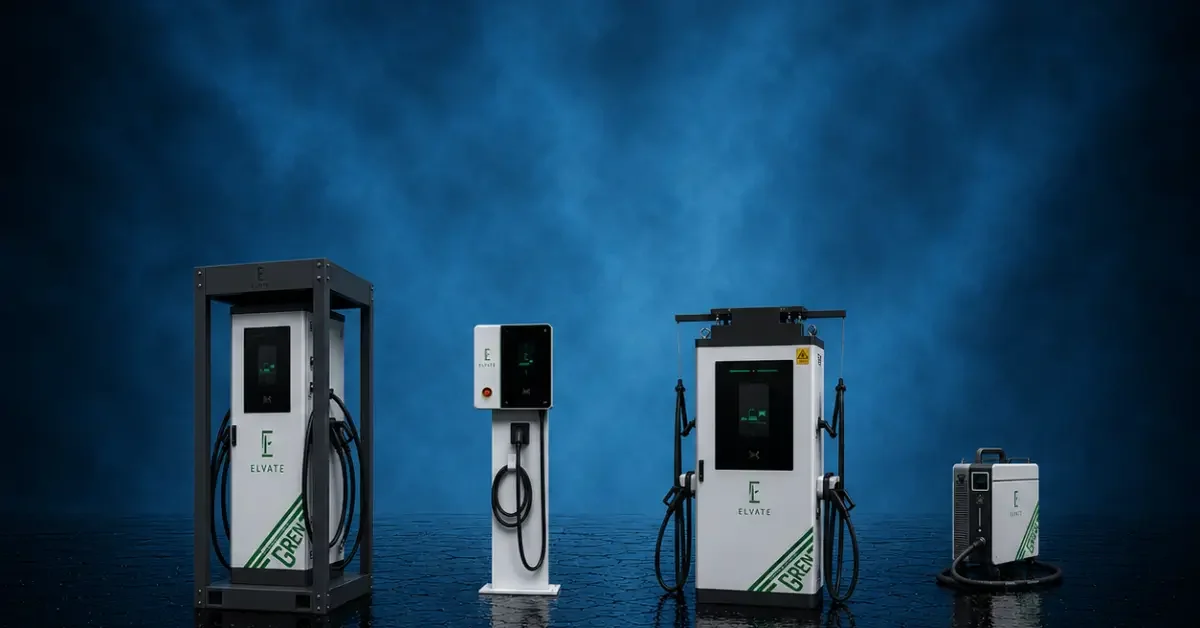
Charger
Charging Solutions for Electric Construction Equipment and Heavy-Duty Vehicles
Ensure fast, safe, and efficient charging with Elvates DC chargers for electric construction equipment, trucks, and heavy-duty vehicles. We offer fast chargers with power ratings ranging from 40 kW to 360 kW, designed for construction sites, industrial facilities, logistics centers, depots, and public charging environments. Our chargers are equipped with CCS2, are available for both fixed and mobile installation, and can be delivered with one or two charging outlets for maximum flexibility. With high operational reliability, smart load balancing, and support for payment solutions, Elvates helps you build a future-proof charging infrastructure that maximizes uptime and productivity.
Our Chargers

40 kW fixed charger

240 kW charger

40 kW mobile charger

240 kW mobile charger, power locks

320 kW charger

320 kW mobile charger, power locks

400 kW charger

400 kW mobile charger, power locks
Fast chargers and charging infrastructure for construction, industry, and logistics
Why choose a charger from Elvate?
Electric machinery is only as efficient as its charging system. Elvate offers DC chargers designed to meet the high power requirements of electric construction equipment and heavy-duty vehicles. With fast charging, machines can be charged during breaks and shift changes, ensuring they’re ready for a full workday.
Since we supply both XCMG’s electric machines and the charging infrastructure, you get a solution where the machines and chargers are tailored to work together. You get the right charging capacity for your fleet without having to coordinate with multiple suppliers.
Smart Charging That Reduces Costs
With smart load balancing, the available power is distributed among multiple machines and vehicles. This allows you to charge more machines at the same time without overloading the electrical connection. It can reduce the need for costly grid upgrades and keep power charges low. With support for payment solutions, the chargers can also be used in shared or public charging environments.
Charging Infrastructure That Lasts
Elvate guides you through the entire process, from needs analysis and sizing to delivery, installation, service, and support in Sweden and Norway. Together, we build a charging infrastructure that meets your current needs and can scale as you electrify more machines.
FAQs
What is a DC charger?
A DC charger is a fast charger that charges the battery with direct current (DC), resulting in a significantly shorter charging time than a traditional AC charger. DC chargers are primarily used for electric cars, electric construction equipment, trucks, buses, and other vehicles with large batteries.
What is the difference between AC and DC charging?
During AC charging, alternating current is converted to direct current in the vehicle’s built-in charger, resulting in a lower charging power. A DC charger, on the other hand, converts the current directly at the charging station and can therefore deliver significantly higher power and faster charging.
Charging time depends on the battery size, the charger’s power, and the vehicle’s maximum charging capacity. A 120–360 kW DC fast charger can charge many electric vehicles and construction machines significantly faster than a standard AC charger.
How fast does a DC fast charger charge?
What is CCS2?
CCS2 (Combined Charging System) is Europe's most common standard for fast charging of electric vehicles. Most modern electric cars, electric construction equipment, and heavy-duty electric vehicles use CCS2 for safe and efficient DC charging.
Which charger is suitable for electric construction equipment?
For electric construction equipment, a DC charger is generally recommended because it offers shorter charging times and higher uptime. The choice of charger depends on battery size, the fleet of machines, and how quickly the machines need to be back in operation.
Fast charging reduces downtime, increases availability, and makes it possible to keep electric vehicles and construction equipment in operation throughout the workday. For businesses, this means higher productivity and better utilization of their fleet.